Use this practical pre-sampling template to turn a garment reference into a focused product decision before measurements, patterns, and technical packs are commissioned.
What a useful fashion design brief decides
A fashion design brief should explain the product opportunity before it describes every technical detail. It connects the reference garment to a target customer, price band, selling platform, assortment role, and reason for development.
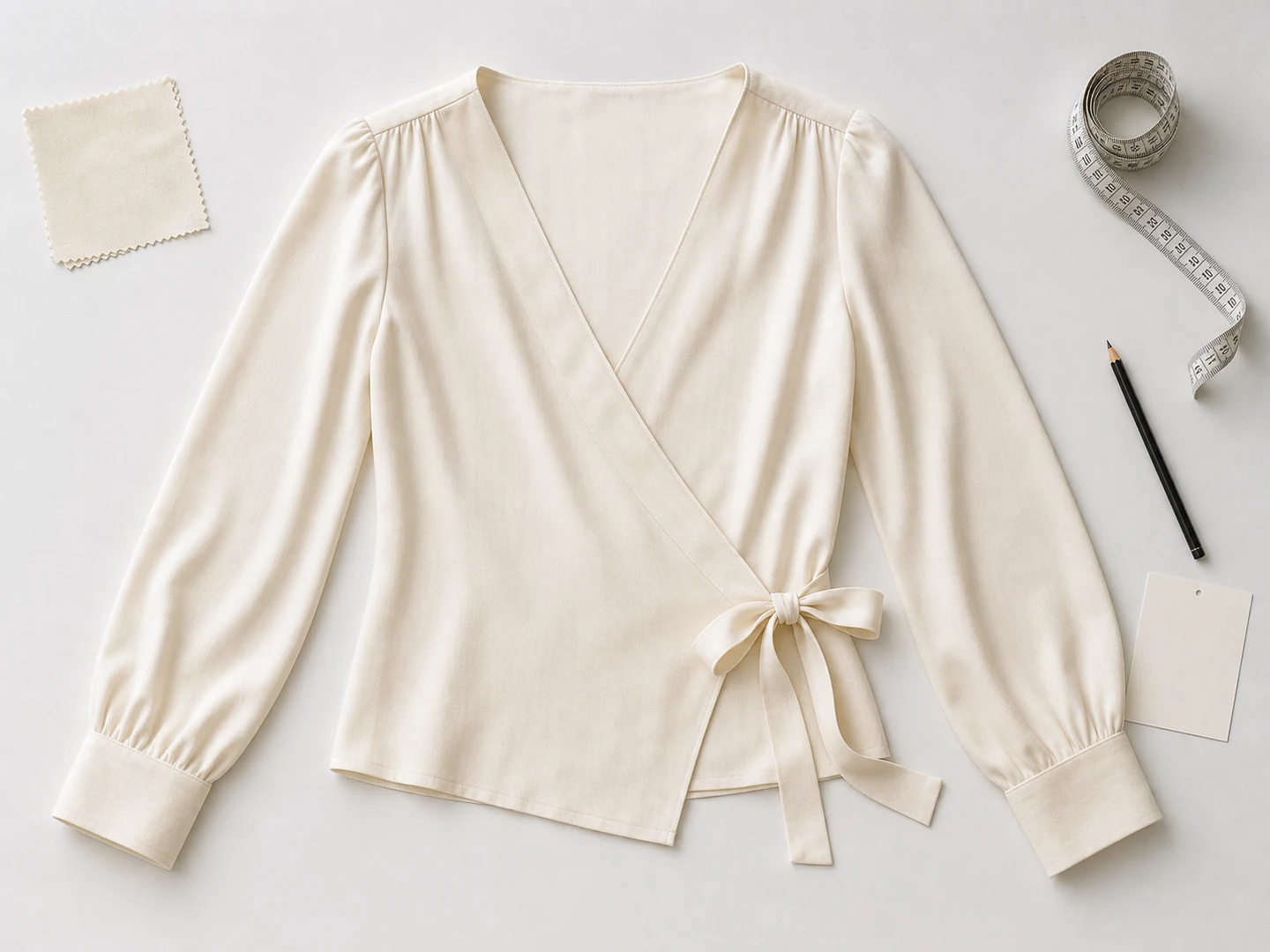
This completed example starts with an ivory wrap blouse for a small Shopify workwear brand. The recognizable cue is the clean wrap front and softly gathered sleeve. Each proposed SKU changes a visible buying reason while keeping the line coherent.
Completed example: ivory wrap blouse capsule
Target customer: women aged 28-42 who want polished workwear that can move from video calls to dinner. Target retail: $58-$78 USD. Season: trans-seasonal spring. Platform: Shopify.
Assortment objective: develop one hero blouse, one lower-risk companion, one occasion-led variant, and one easier-care option without creating four unrelated bodies.
What belongs in the next technical step
The brief is an upstream decision document, not a production tech pack. After selecting a direction, a technical designer should add graded measurements, construction callouts, tolerances, bill of materials, artwork, testing requirements, and compliance information.
Completed sample brief
Ivory wrap blouse capsule
A four-SKU work-to-dinner line built around a soft wrap front, matte drape, and restrained sleeve volume.
- Customer
- Women 28-42, office and hybrid work
- Retail
- $58-$78 USD
- Platform
- Shopify DTC
- Material direction
- Opaque matte viscose blend
Completed variant plan
V1. Signature wrap blouse
Design change: Preserve the wrap front; refine the tie length and add a discreet internal security button.
Selling point: Polished shape that stays secure through a full workday.
Production risk: Neckline gaping and tie placement must be checked across the graded size range.
V2. Clean popover companion
Design change: Remove the external waist tie and use a short concealed side zip with a straighter hem.
Selling point: Lower-fuss styling for repeat weekday wear.
Production risk: The simplified body can lose the recognizable waist cue if ease is not controlled.
V3. Evening cuff edition
Design change: Keep the body and add a wider covered cuff with a subtle fabric-covered button.
Selling point: A visible occasion detail without commissioning a completely new block.
Production risk: Covered-button MOQ and cuff pressing may raise labor cost and shade variation.
V4. Easy-care travel blouse
Design change: Use a wrinkle-light recycled blend and reduce sleeve gathering by approximately one third.
Selling point: Packable workwear with a cleaner sleeve under jackets.
Production risk: Substitute fabric must be tested for opacity, recovery, pilling, and wrap-front drape.
Approval checks before sampling
- Confirm front overlap and neckline coverage on at least three base sizes.
- Review tie, button, and trim MOQ before committing to color count.
- Test opacity in ivory under daylight and strong studio lighting.
- Do not claim wrinkle resistance until the selected fabric is physically tested.
Download completed PDF example
Download editable DOCX template
Illustrative ModaExtend sample created for education. Final fit, construction, costing, testing, and compliance require qualified supplier and technical review.